
IT AMC in India: What Large Enterprises Should Know Before Signing a Maintenance Contract
Team Blue Monk · 12 October 2026
An Annual Maintenance Contract looks simple on paper. A company pays a fixed amount and the service provider keeps its IT equipment running.
An annual maintenance contract looks simple on paper. A company pays a fixed amount and the service provider keeps its IT equipment running.
For a large enterprise, it is rarely that straightforward.
A weak AMC can leave teams arguing over whether an asset is covered, waiting for replacement parts or discovering that a critical location falls outside the agreed service scope.
That is why enterprises evaluating an IT AMC in India should look beyond annual pricing.
The real question is whether the contract can keep equipment available, reduce operational disruption and provide consistent support across the organisation.
What Is an IT AMC?
An IT Annual Maintenance Contract is an agreement under which a service provider maintains defined IT hardware or infrastructure for an agreed period.
Depending on the contract, an AMC may cover:
- Preventive maintenance
- Hardware troubleshooting
- Break-fix support
- Component replacement
- On-site engineer visits
- Remote support
- Spare management
- OEM coordination
- Escalation management
The scope can range from a few hundred endpoints to complex enterprise environments involving servers, networking equipment and multiple office locations.
For large organisations, the quality of an AMC depends less on the label and more on exactly what the contract includes.
Why Enterprise IT AMC Requirements Are Different
Supporting one office is different from supporting an enterprise technology estate.
Large organisations may operate across corporate offices, manufacturing plants, warehouses, data centres and regional branches.
A failure at one site may affect an individual employee. A failure at another may affect hundreds of users or interrupt an operational process.
This means an enterprise IT AMC needs to account for:
- Multiple locations
- Different asset categories
- Criticality levels
- Extended support hours
- Spare availability
- Escalation paths
- Reporting requirements
- Different response expectations
A standard maintenance contract designed for a small business will rarely be enough.
What Should an Enterprise IT AMC Cover?
Before signing a contract, define exactly which assets and activities are included.
1. Complete Asset Scope
The AMC should clearly identify what equipment is covered.
This may include:
- Laptops and desktops
- Servers
- Networking equipment
- Storage systems
- Printers and peripherals
- UPS systems
- Meeting-room equipment
- Other infrastructure hardware
Asset-level records are especially important for large environments.
If serial numbers, locations and asset categories are unclear, disputes over coverage become much more likely.
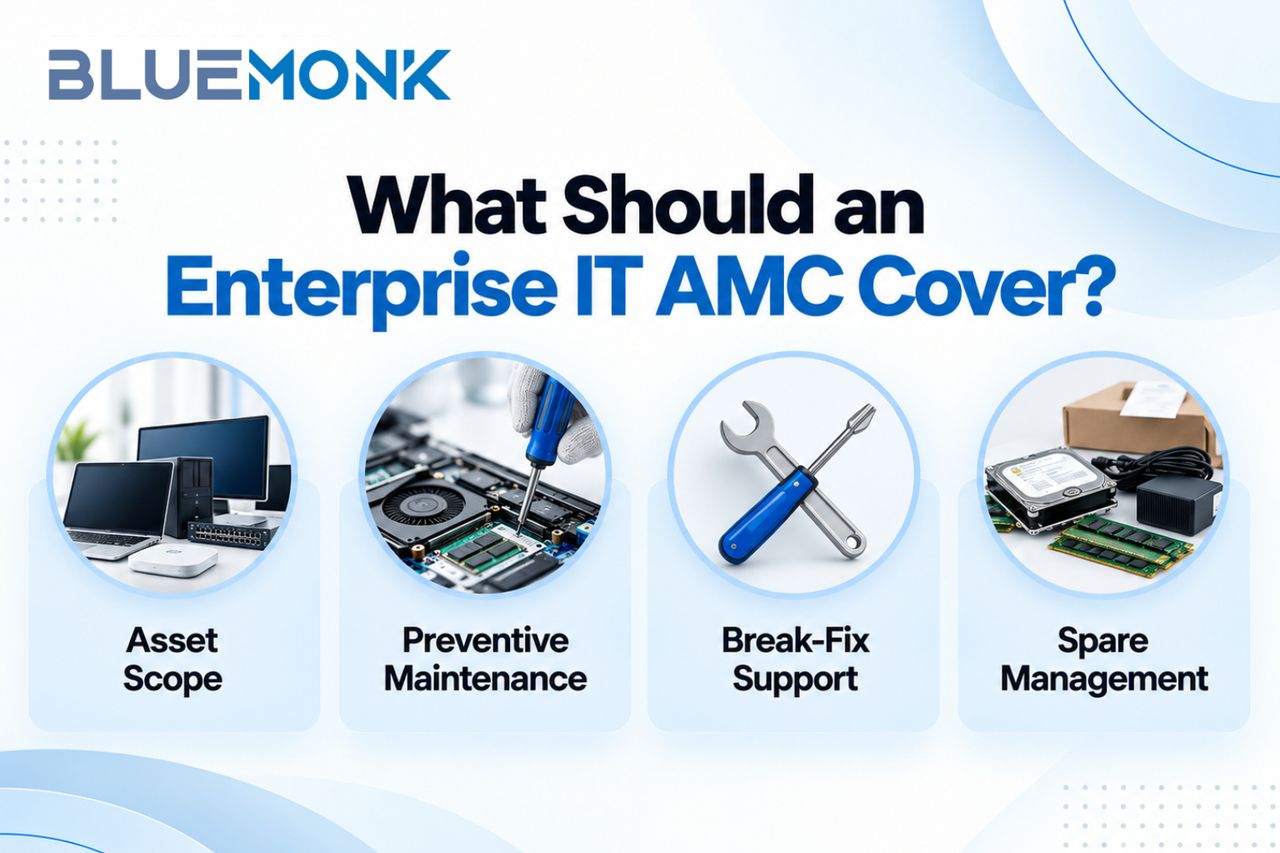
2. Preventive Maintenance
An AMC should not begin only after something breaks.
Preventive maintenance can help identify potential issues before they become business interruptions.
Depending on the equipment, this may include:
- Hardware health checks
- Physical inspection
- Cleaning
- Performance checks
- Firmware review
- Connectivity checks
- Power and environmental checks
The exact maintenance schedule should be documented rather than left open to interpretation.
3. Break-Fix Support
When equipment fails, the contract should define what happens next.
Enterprises should know:
- Who logs the incident?
- Who diagnoses it?
- Is remote troubleshooting attempted first?
- When is an engineer dispatched?
- What happens if a component needs replacement?
- Who coordinates with the OEM?
A good enterprise IT support process removes ambiguity from these steps.
The SLA Matters More Than the AMC Price
Price is easy to compare.
Service levels are harder, but they usually matter more when something goes wrong.
Before signing an IT AMC in India, enterprises should review the SLA carefully.
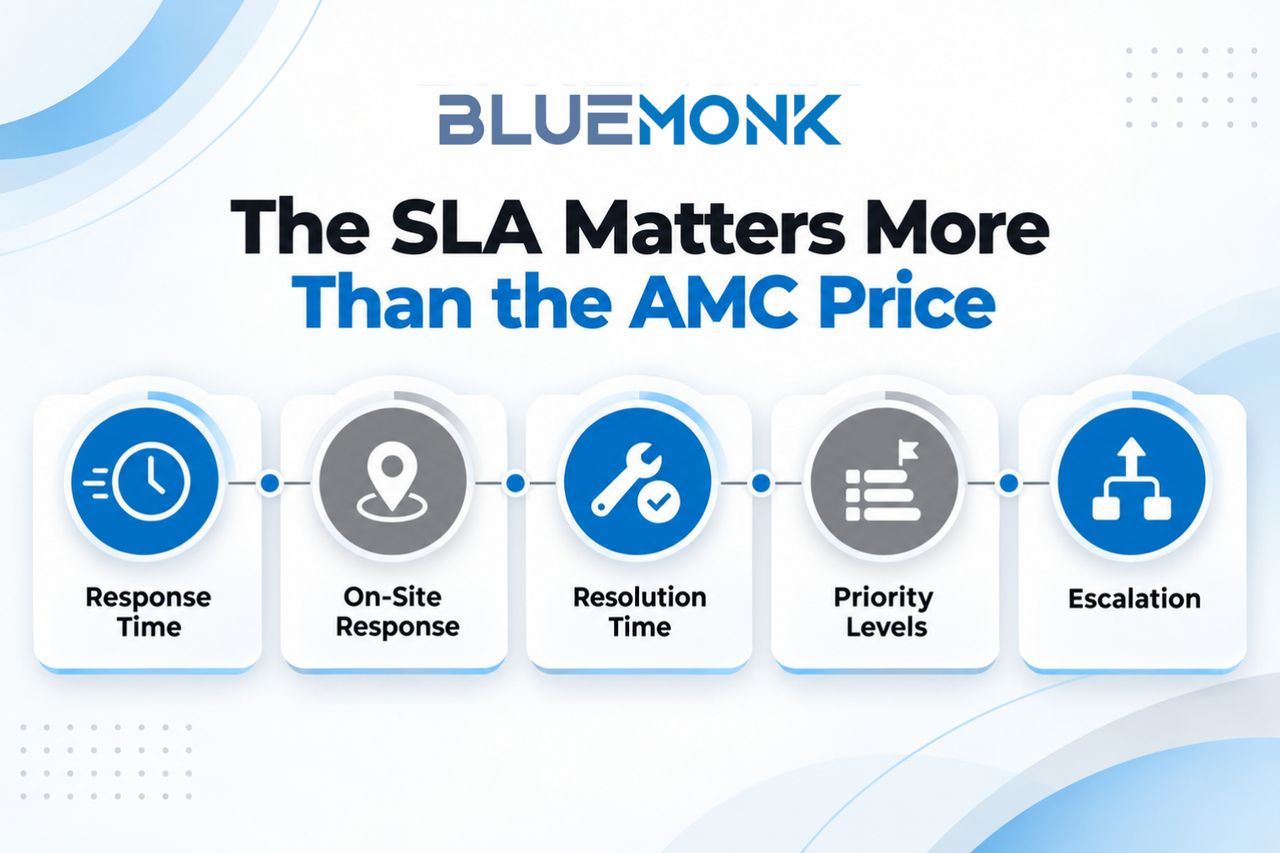
Response Time
How quickly will the provider acknowledge the issue?
On-Site Response
If physical intervention is required, how quickly will an engineer reach the location?
Resolution or Restoration Time
Does the SLA define when the equipment should be fixed or when an alternative should be provided?
Priority Levels
A failed employee laptop should not necessarily receive the same priority as a failed core network device.
Escalation
The contract should identify who becomes responsible if the original support team cannot resolve the issue.
Avoid vague commitments such as “best effort” for business-critical equipment.
Ask What Happens When Parts Are Required
Spare availability can make or break an AMC.
A technician may identify the issue quickly, but that does not help much if the required replacement component takes several days to arrive.
Before signing, ask:
- Which parts are covered?
- Which parts are excluded?
- Are commonly required spares stocked?
- Where are those spares stored?
- Who pays for replacement components?
- Are OEM parts required?
- What happens when an older part is no longer available?
For critical assets, enterprises may also consider maintaining dedicated spare inventory or buffer equipment.
Understand Comprehensive vs Non-Comprehensive AMC
This distinction can significantly affect both pricing and responsibility.
Comprehensive AMC
A comprehensive AMC generally includes maintenance labour and defined replacement parts within the agreed fee.
However, exclusions still matter. Enterprises should check whether items such as batteries, consumables or damaged parts are excluded.
Non-Comprehensive AMC
A non-comprehensive AMC may cover maintenance and labour while replacement components are billed separately.
The contract may appear cheaper initially but can create more variable costs during the year.
Neither model is automatically better.
The right choice depends on asset condition, criticality, replacement-part costs and how predictable the organisation needs its IT maintenance budget to be.
Multi-Site Coverage Should Be Written Into the Contract
For enterprises operating across India, geography matters.
A provider may be strong in one metro but depend entirely on third parties elsewhere.
Before signing a multi-site IT AMC, ask where the provider has:
- Direct engineers
- Field support capability
- Spare inventory
- Logistics support
- Escalation teams
- Partner-based coverage
Also ask whether SLAs remain the same across all locations.
A four-hour response commitment in Delhi is not meaningful if a plant in another state receives a next-business-day response.
For enterprises with distributed technology estates, an IT lifecycle management partner should be able to coordinate support consistently across locations rather than treating every site as a separate service arrangement.
Check the Exclusions Before the Inclusions
Most AMC problems start with assumptions.
The enterprise thinks something is covered. The service provider points to an exclusion.
Review exclusions carefully before signing.
Common exclusions may include:
- Accidental physical damage
- Liquid damage
- Consumables
- Batteries
- Obsolete equipment
- Unsupported operating systems
- Equipment modified by another vendor
- Damage caused by power issues
- Accessories
- Third-party software problems
Exclusions are not necessarily a problem.
Unclear exclusions are.
Everything that matters operationally should be agreed before the contract begins.
Do Not Ignore Asset Age
An AMC covering a three-year-old environment is very different from one covering equipment that has been operating for seven or eight years.
Older hardware can mean:
- Higher failure rates
- Harder-to-source parts
- Longer resolution times
- Reduced OEM support
- Higher maintenance costs
Before accepting an ageing environment into an AMC, the provider should ideally assess the installed base.
Enterprises should also ask whether maintaining certain assets still makes financial sense.
Sometimes replacement is a better decision than repeatedly repairing equipment that has reached the end of its useful life.
AMC and Managed IT Services Are Not the Same
The terms are sometimes used interchangeably, but they solve different problems.
An AMC Primarily Maintains Assets
The focus is typically on ensuring covered equipment remains operational.
Managed IT Services Manage Ongoing IT Operations
Managed services can include:
- Service desk
- Desk-side support
- Infrastructure operations
- User support
- Workforce management
- Monitoring
- Escalation management
A company may need one or both.
For example, an organisation may use an AMC to maintain network equipment while using a broader managed IT services model for day-to-day enterprise support.
The important thing is to define where one service ends and the other begins.
Reporting Should Be Part of the Contract
A good AMC should generate useful operational data.
Enterprise reporting may include:
- Number of incidents
- Asset-wise failure history
- Response SLA performance
- Resolution performance
- Repeat failures
- Spare usage
- Open incidents
- Preventive maintenance status
- Escalations
This information helps IT teams identify patterns.
If the same device model is failing repeatedly, for example, the issue may no longer be maintenance. It may be time to plan a refresh.
Seve2n Questions to Ask Before Signing an IT AMC
1. Exactly Which Assets Are Covered?
Ask for a clear asset list rather than relying on broad equipment categories.
2. What Are the Response and Resolution SLAs?
Make sure the contract separates acknowledgement, engineer response and final resolution.
3. Are Replacement Parts Included?
Understand which parts are included, excluded or billed separately.
4. Can the Provider Support Every Location?
Confirm actual service capability at every enterprise site.
5. Who Handles OEM Escalations?
The contract should clarify whether your team or the AMC provider manages OEM coordination.
6. What Happens When an Asset Cannot Be Repaired?
Define replacement, temporary swap or escalation procedures.
7. What Reporting Will We Receive?
Reports should help the enterprise understand service performance and asset health, not simply provide a list of closed tickets.
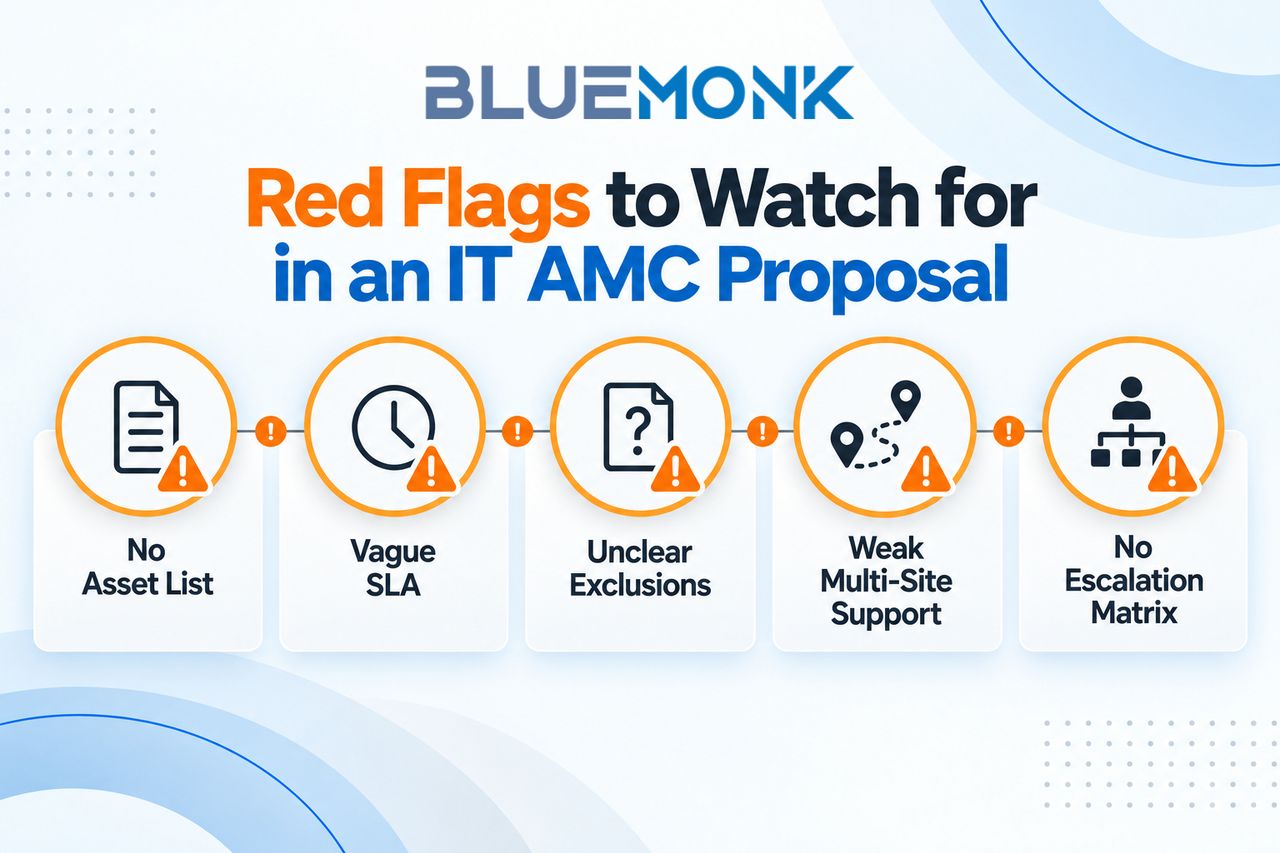
Red Flags to Watch for in an IT AMC Proposal
Be cautious if the proposal:
- Does not include an asset list
- Uses vague SLA language
- Does not explain spare availability
- Has unclear exclusions
- Cannot explain multi-site support
- Provides no escalation matrix
- Offers no preventive maintenance schedule
- Does not include regular service reporting
A low AMC price can become expensive if every important requirement sits outside the contract.
Choosing an IT AMC Partner in India
For a large enterprise, the right partner should combine technical capability with operational discipline.
Look for:
Multi-Site Delivery Capability
The provider should be able to maintain service consistency across enterprise locations.
Clear SLAs
Every important response, escalation and restoration commitment should be measurable.
Skilled Technical Resources
The team should have the right capability for the equipment included in the contract.
Strong Escalation Processes
Problems should not stall because ownership is unclear.
Spare and Logistics Capability
Replacement parts need to reach the right location quickly.
Lifecycle Understanding
The provider should be able to tell you when an asset should stop being repaired and start being considered for replacement or retirement.
Frequently Asked Questions
What is an IT AMC?
An IT AMC, or Annual Maintenance Contract, is an agreement under which a service provider maintains defined IT hardware or infrastructure for a fixed period. The scope may include preventive maintenance, troubleshooting, repairs, parts replacement and on-site support.
What is the difference between comprehensive and non-comprehensive AMC?
A comprehensive AMC generally includes agreed replacement parts along with maintenance services. A non-comprehensive AMC typically covers service and labour while parts are charged separately. Exact coverage depends on the individual contract.
What should an enterprise IT AMC include?
An enterprise AMC should clearly define covered assets, locations, SLAs, preventive maintenance, break-fix procedures, spare arrangements, exclusions, escalation paths and service reporting.
Is IT AMC suitable for companies with multiple locations in India?
Yes, but the provider should demonstrate actual multi-site delivery capability. Enterprises should confirm whether response SLAs, technical support and spare availability remain consistent across all covered locations.
How should enterprises evaluate an IT AMC provider?
Evaluate technical capability, asset coverage, response and resolution SLAs, spare availability, geographic coverage, escalation processes, reporting and the provider's ability to support ageing hardware.
When should an enterprise replace an asset instead of maintaining it?
Replacement may make more sense when an asset experiences repeated failures, has limited spare availability, is no longer supported by the OEM or costs too much to maintain compared with replacing it.