
Managed IT Services in Delhi NCR: What Enterprise Companies Should Expect from a Partner
Team Blue Monk · 8 October 2026
Enterprise IT support becomes difficult long before the technology itself becomes complex.
Enterprise IT support becomes difficult long before the technology itself becomes complex.
A growing workforce, multiple offices, hybrid employees, business-critical infrastructure and extended operating hours can quickly turn day-to-day IT support into a coordination problem.
That is why companies looking for managed IT services in Delhi NCR should evaluate more than response time or ticket closure.
A strong managed services provider in Delhi NCR should help the organisation run support consistently across users, locations and infrastructure while giving internal IT teams clearer visibility and accountability.
What Are Managed IT Services?
Managed IT services are ongoing technology support services delivered by an external partner under an agreed scope.
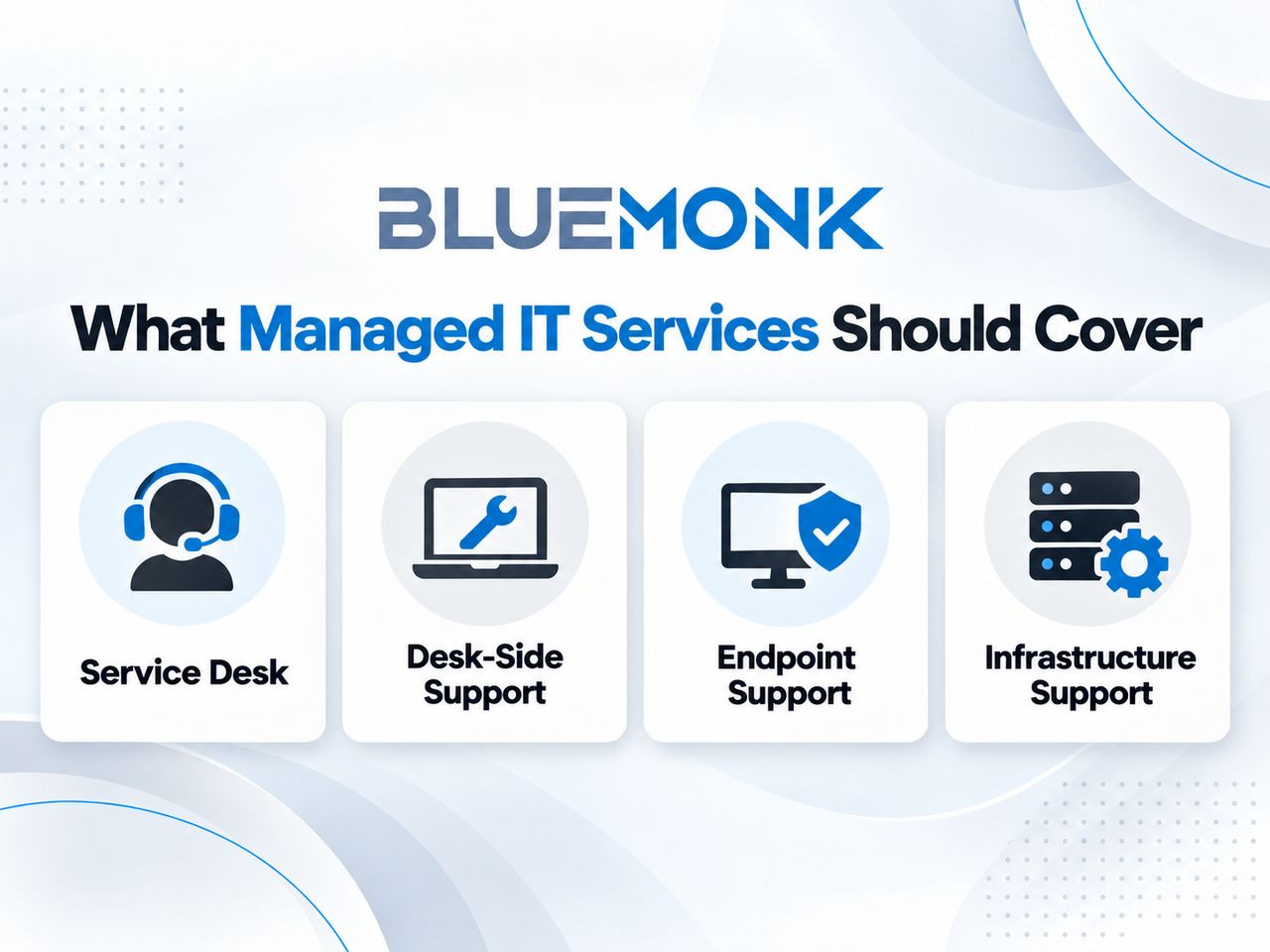
Instead of hiring separate teams for every support requirement, enterprises can use a managed services partner for functions such as:
- Service desk support
- Desk-side IT support
- Endpoint troubleshooting
- Infrastructure operations
- User onboarding and offboarding
- Hardware replacement
- Network support
- Meeting-room technology support
- Shift and workforce management
The exact scope depends on the organisation.
For some companies, managed services may cover the entire support environment. For others, the provider works alongside an internal IT team and takes responsibility for specific functions or locations.
Why Enterprises in Delhi NCR Use Managed IT Services
Delhi NCR has a high concentration of corporate offices, GCCs, BPOs, technology companies, manufacturing operations and multi-location enterprises. This is why demand for enterprise IT services in Delhi continues to grow.
These organisations often need IT support across Delhi, Gurugram, Noida and surrounding locations while maintaining one standard of service.
A structured enterprise IT support model can help when support demand grows faster than an internal team can scale. Many organisations choose outsourced IT support in Delhi NCR for exactly this reason.
Typical challenges include:
- Increasing ticket volumes
- Users working across multiple sites
- Different support processes at different offices
- Extended or shift-based operating hours
- Difficulty recruiting and retaining IT support staff
- Slow escalation between teams
- Limited visibility into recurring support issues
Managed services should reduce this operational friction rather than simply add another vendor to manage.
What Should Managed IT Services in Delhi NCR Include?
Not every enterprise needs the same scope, but there are several areas buyers should evaluate when comparing managed IT support in Delhi NCR.
1. Service Desk Support
The service desk is usually the first point of contact when an employee has a technology issue.
A managed service desk should be able to handle:
- Ticket logging and categorisation
- First-line troubleshooting
- Remote support
- Ticket escalation
- User communication
- Knowledge-base management
- Repeat-issue identification
The objective should not be only to close tickets.
A good service desk should also help identify recurring problems and reduce preventable support demand over time.
2. Desk-Side Support
Some problems cannot be resolved remotely.
Enterprises with larger offices often need engineers physically available for:
- Laptop and desktop troubleshooting
- Hardware replacement
- Peripheral issues
- New employee setup
- Employee moves
- Meeting-room support
- Device collection
- Basic infrastructure checks
For businesses operating across Delhi NCR, the important question is whether the provider can maintain a consistent process across every location.
3. Endpoint and User Support
Laptops and desktops are central to employee productivity.
A managed IT partner should support the operational side of the endpoint lifecycle, including deployment, troubleshooting, replacement and recovery.
This becomes more valuable when connected with broader technology lifecycle management rather than being treated as an isolated support activity.
A device that fails should not create separate conversations for diagnosis, replacement, logistics and asset recovery.
The process should already be connected.
4. IT Infrastructure Support in Delhi NCR
Managed services can extend beyond user devices.
Depending on the environment, IT infrastructure support in Delhi NCR may include:
- Servers
- Networking
- Wireless infrastructure
- Storage
- Data centre equipment
- Security infrastructure
- Monitoring
- Vendor coordination
For enterprise environments, the provider should clearly define what is covered directly and what requires escalation to an OEM or specialist team.
SLAs Should Be Specific, Not Generic
One of the first things enterprise buyers should ask about is the service-level agreement.
Terms such as “fast support” or “quick resolution” are not enough.
A useful SLA should define:
- Response time
- Resolution or restoration targets
- Priority levels
- Escalation paths
- Support hours
- On-site response where required
- Reporting frequency
- Responsibilities of each party
The SLA should also reflect business impact.
A failed laptop for one employee and a network outage affecting an entire floor should not be treated in the same way.
Look Beyond Ticket Closure
A managed services partner should not be measured only by how many tickets it closes.
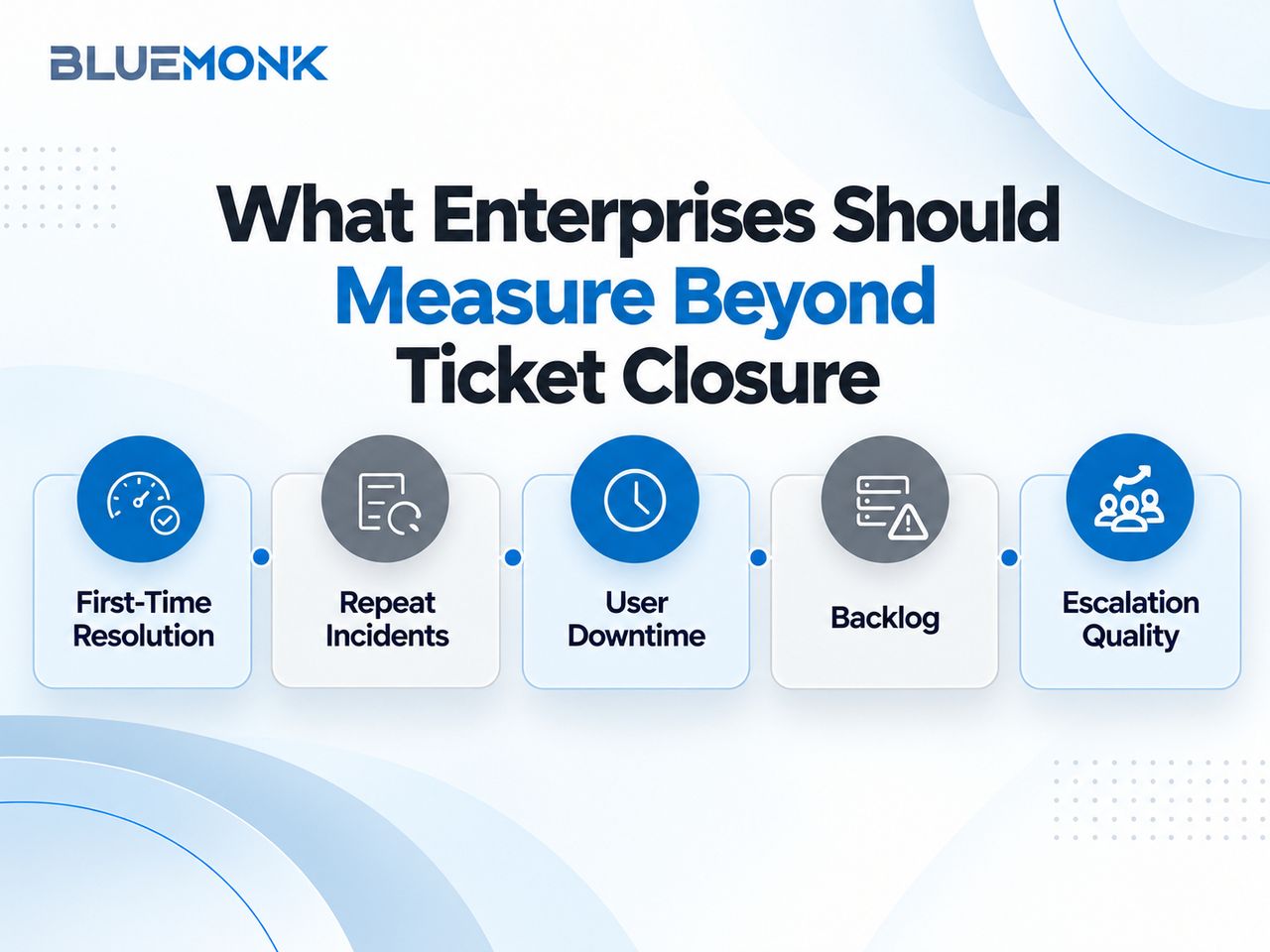
Enterprise IT teams should also look at:
First-Time Resolution
How many issues are resolved without repeated escalation?
Repeat Incidents
Are the same problems appearing again and again?
User Downtime
How long are employees unable to work?
Backlog
Are unresolved tickets accumulating?
Asset Failure Patterns
Are particular models, locations or infrastructure components creating more incidents?
Escalation Quality
When a problem needs another team or vendor, is the escalation structured and documented?
These measures provide a better picture of support quality than ticket volume alone.
Managed IT Services Should Scale With the Business
Support requirements rarely remain static.
A company may open a new office, increase headcount, extend operating hours or add new infrastructure.
A managed services partner should be able to adjust without forcing the customer to rebuild the support model every time.
BlueMonk’s managed services scale-up case study shows this in practice. A resident support team covering service desk, desk-side support and infrastructure operations scaled from 68 to 94 resources as the customer’s estate and headcount grew. The model also covered multiple delivery locations and extended operating hours.
That is the type of scalability enterprise buyers should look for.
Local Presence Matters in Delhi NCR
Remote support is useful, but enterprise environments still require physical intervention.
A provider supporting Delhi NCR should have practical capability across key business locations rather than depending entirely on ad hoc field resources. Whether you need IT support services in Gurgaon (Gurugram), Noida or Delhi, the provider should be able to deliver the same standard of service.
BlueMonk lists direct delivery presence in Gurugram and New Delhi, alongside broader pan-India coverage.
For enterprise buyers, local capability can make a difference when the requirement involves:
- Resident engineers
- Device replacement
- Office moves
- Infrastructure incidents
- New-site deployment
- Asset recovery
- Emergency on-site support
A Managed Services Partner Should Understand the Full IT Lifecycle
Support does not happen in isolation.
A laptop issue may eventually lead to replacement.
A hardware refresh may create hundreds of devices that need to be collected.
A new office may require procurement, deployment, networking and ongoing support.
This is why enterprises should consider whether their managed services provider in Delhi NCR can work across the wider technology lifecycle.
A connected model can cover:
Source → Build → Maintain → Retire
This reduces handoffs between separate vendors and makes accountability clearer.
BlueMonk positions procurement, deployment, support, logistics and retirement as connected stages within the same enterprise technology lifecycle.
Questions to Ask Before Choosing a Managed IT Services Partner
Can You Support All Our Locations?
The provider should clearly explain where it has direct capability and where it relies on partner resources.
What Happens Outside Standard Business Hours?
If your operations run in shifts, support coverage should match those hours.
How Do You Handle Escalations?
Ask who owns a ticket when it moves between service desk, desk-side, infrastructure or OEM support.
How Do You Measure Performance?
Look beyond basic ticket closure numbers. Reporting should provide visibility into service quality, recurring issues and SLA performance.
Can the Team Scale?
Understand how additional users, sites or shifts would be added to the service model.
Who Owns Asset and Support Data?
Your organisation should retain visibility and control over its information.
Can You Support Hardware and Lifecycle Events Too?
A partner that can connect support with deployment, replacement, recovery and retirement can reduce unnecessary vendor handoffs.
Common Red Flags When Evaluating a Provider
Be cautious when a provider:
- Cannot clearly define its SLA
- Relies entirely on generic remote support
- Has no clear escalation model
- Cannot explain staffing or backfill arrangements
- Offers the same service model to every customer
- Provides little operational reporting
- Has weak visibility across multiple locations
- Treats endpoint support, infrastructure and asset lifecycle as completely separate services
Managed services should make IT operations easier to govern, not harder.
How BlueMonk Approaches Managed IT Services
BlueMonk supports enterprise technology across procurement, deployment, managed support and retirement.
Its managed services capability can include service desk, desk-side support, infrastructure operations, workforce management and multi-site support.
The wider BlueMonk model also connects support with lifecycle stages such as hardware procurement, device deployment, logistics, recovery and retirement.
For enterprise organisations in Delhi NCR, this means managed services can sit within a broader technology operating model rather than functioning as a standalone helpdesk.
Final Thoughts
The right managed IT services partner should do more than respond when something breaks.
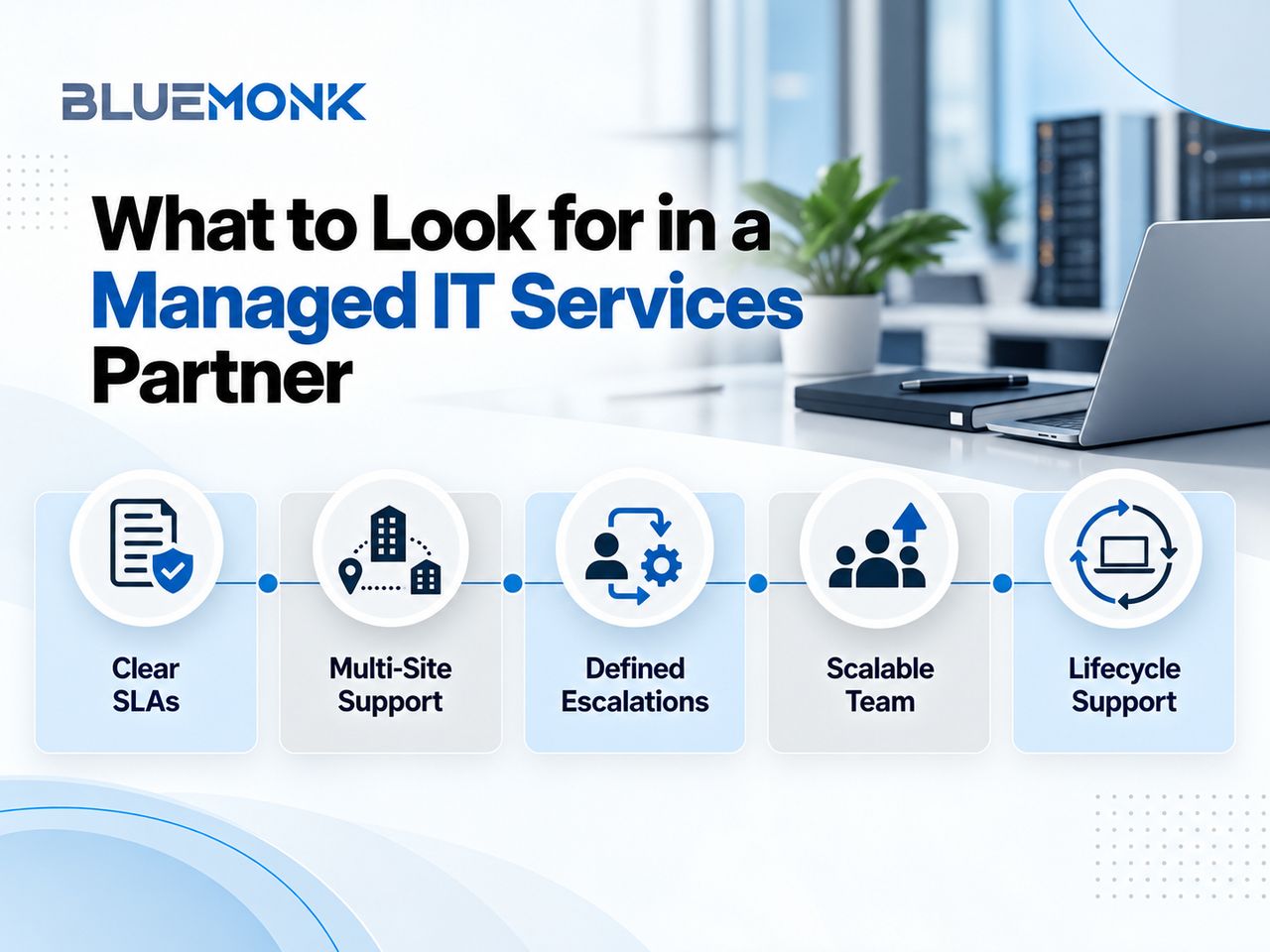
Enterprise companies should expect structured processes, clear SLAs, skilled support resources, multi-site capability, useful reporting and the ability to scale as the business changes. These expectations apply whether you are choosing enterprise IT services in Delhi or enterprise IT support in India more broadly.
For organisations evaluating managed IT services in Delhi NCR, the most important question is not simply, “Can this provider support our users?”
It is:
Can this partner consistently support our people, devices and infrastructure as the organisation grows?
If the answer is yes, managed services becomes more than outsourced support. It becomes part of how the enterprise runs IT.
Talk to the BlueMonk team about managed IT support, multi-site delivery and enterprise technology lifecycle requirements across Delhi NCR.
Frequently Asked Questions
What are managed IT services?
Managed IT services are ongoing IT support and operational services provided by an external technology partner under an agreed scope, service model and SLA.
What do managed IT services in Delhi NCR usually include?
Depending on the requirement, managed IT support in Delhi NCR can include service desk support, desk-side support, endpoint management, infrastructure operations, hardware replacement, user onboarding and multi-location support.
Why do enterprises outsource IT support?
Enterprises may choose outsourced IT support in Delhi NCR to gain access to structured processes, additional technical resources, extended support coverage and easier scalability without building every capability internally.
What should an enterprise look for in a managed services provider?
When choosing a managed services provider in Delhi NCR, look for clear SLAs, defined escalation paths, strong local and multi-site capability, experienced resources, useful reporting and the ability to scale with changing business requirements.
Are managed IT services suitable for multi-location companies?
Yes. A structured managed services model can help standardise support across offices, branches and distributed users while maintaining consistent processes and reporting. This applies to enterprise IT support in India as well as across Delhi NCR.
Why is local support important in Delhi NCR?
Enterprise IT issues often require physical intervention for hardware, infrastructure, office moves or device recovery. Local capability, including IT support services in Gurgaon, Noida and Delhi, can reduce operational delays when remote support is not enough.